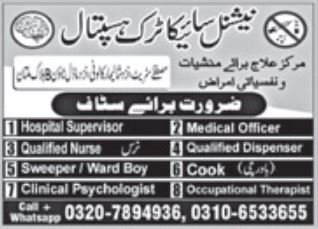
The Reality Behind the White Coat: Why National Psychiatric Hospital Multan Jobs Are Not Your Average Government Posts
Most job seekers scroll through newspaper ads with a glazed look—same cities, same BPS scales, same generic “walk-in interview” line. Then, they hit the National Psychiatric Hospital Multan advertisement and pause. There’s a visceral reaction to the word “Psychiatric.” Some click away because they think it means “pagal khana” work. Others get intrigued but have zero clue what a clinical psychologist actually does in a government setup versus a private clinic in DHA.
Here is the hard truth: The public sector mental health space in Southern Punjab is both severely understaffed and critically important. If you land a role here—especially as a Medical Officer, Psychologist, or Occupational Therapist—you aren’t just getting a monthly paycheque. You’re entering a niche specialization that is slowly gaining the recognition it deserves in Pakistan’s healthcare infrastructure. This isn’t a filing job; it’s front-line, sometimes high-pressure, patient interaction. And the hiring process? It filters out the faint-hearted before the interview even starts.
Let’s break down exactly what’s on offer, who actually stands a chance, and the unspoken rules of landing a job at Model Town’s most specialized medical facility.
Quick Job Snapshot: National Psychiatric Hospital Multan 2026
Before we dig into strategy, let’s get the bare facts on the table. This is what you’re working with based on the April 11, 2026, Khabrain Newspaper notification.
| Organization | National Psychiatric Hospital, Model Town, Multan |
| Location | Multan, Punjab, Pakistan |
| Last Date to Apply | Check Official Ad (Typically 15-20 days from publication, likely end of April 2026) |
| Total Posts | Multiple (Exact number varies per quota, but significant hiring drive for nursing and allied staff) |
| Education Range | Matric, Intermediate, DAE, Bachelor’s, MBBS |
| Job Type | Government (Likely Contract leading to Regularization as per Punjab Policy) |
About the Organization: More Than Just a Hospital
National Psychiatric Hospital Model Town Multan is a specialized tertiary care facility. In the hierarchy of Punjab healthcare, this isn’t a Basic Health Unit (BHU) or a Rural Health Center (RHC). It’s a specialized institute. That matters for two reasons: Patient Volume and Professional Exposure. You will see cases here that a general physician in a DHQ hospital might see once a month.
Why do people want to work here? Stability is the obvious answer, but the hidden perk is the clinical exposure to psychopharmacology and therapeutic rehabilitation. For nurses and psychologists, this is a rare resume booster. However, the reputation is also one of high burnout risk. You are dealing with acute psychosis, substance abuse rehabilitation, and chronic mental illness. It requires a specific temperament. If you are just looking for a “light government duty” where you can scroll on your phone, you will be miserable here, and frankly, the staff will make that clear to you.
What Makes This Hiring Drive Different?
This is not an annual ritual like PPSC general recruitment. National Psychiatric Hospital Multan hiring comes in waves based on patient load and budget releases. The inclusion of posts like Occupational Therapist and Clinical Psychologist signals a shift toward a multi-disciplinary approach.
The hidden value here is specialization allowance potential (especially for nurses working in psychiatric wards) and the fact that these positions are often less “political” than those in district administrations. Why? Because the skill set is niche. A random sifarish with a BA degree can’t walk into the Clinical Psychologist seat—they need the actual degree and HEC/PEC registration. This acts as a natural filter, making the competition slightly more merit-based than a generic Clerk post.
Vacancies & Eligibility Breakdown (Simplified)
Here is the realistic breakdown of what each role entails beyond the education column:
- Medical Officer (MBBS): Valid PMDC/PMC registration required. Fresh graduates can apply, but preference often goes to those with House Job experience in Psychiatry or Medicine. You’ll be managing acute admissions and medical comorbidities.
- Clinical Psychologist (Bachelor/Masters in Psychology): This is the most competitive non-medical seat. You need specific coursework in clinical psychology and preferably an internship from a recognized institute. Diploma holders beware: a generic BA with Psychology as an elective usually won’t cut it.
- Occupational Therapist (Bachelor/DAE): Relatively lower competition because fewer people have this specific diploma/degree. If you have a DAE in Rehabilitation Sciences, this is your golden ticket.
- Qualified Nurse / Nurse (BSc Nursing / Diploma): PNC card valid in Punjab is non-negotiable. The “Qualified Nurse” post likely demands a BSc (4-year degree), while “Nurse” may accept the 3-year Diploma. There is a massive demand for male nurses in psychiatric settings for handling aggressive patients.
- Dispenser / Qualified Dispenser (Intermediate/Matric with Dispenser Course): High competition. Hundreds of applicants with Pharmacy Technician/Compounder certificates apply for these. The difference between “Qualified” and regular is usually the level of certification (Category A vs B).
- Hospital Supervisor (Bachelor/Relevant Experience): This is an administrative role. Expect questions on inventory management and hospital waste disposal during the interview.
The Real Competition Insight: Who Are You Really Up Against?
Let’s be blunt about the numbers. For every Medical Officer post, expect 50-80 applicants. The supply of MBBS doctors exceeds the demand even in specialized units. For Nurse posts, expect 100+ applicants per seat, especially female quota seats. However, for Occupational Therapist, you might be looking at a ratio of 10:1 or even 5:1 simply because the talent pool in South Punjab is shallow for this field.
Where do most people fail? The verification of registration. This is a psychiatric hospital. They will check with the Pakistan Nursing Council (PNC) and Pakistan Medical Commission (PMC) religiously. If your registration is expired by even one day, or if you have a provisional certificate but not the full one, your application goes in the “Rejected” pile immediately. I’ve seen this happen too many times to count. If you want to understand the deeper psychology of why candidates fail these tests, you might want to read this breakdown on why most candidates fail government job tests—it applies doubly here.
The Selection Process: What Actually Happens Behind the Door
There is no PPSC exam for these specific hospital-based posts unless it’s a BPS-17 scale (Medical Officer). The hospital administration usually forms a Departmental Selection Committee. Here is the realistic flow:
- Application Scrutiny: 30% of candidates are eliminated here for missing documents or wrong domicile.
- Written Test (If applicable for lower posts): For Dispensers and Nurses, expect a 50-mark MCQs paper. Focus: Pharmacology for psychiatric drugs (Haloperidol, Lorazepam, SSRIs). They will ask about side effects. Generic nursing questions won’t save you here.
- Practical Demonstration / Interview: For Psychologists, you will be given a case vignette. For OTs, you will be asked about activity scheduling for a depressed patient. This is where theory meets reality.
- Final Selection: It’s a mix of merit and the board’s gut feeling about your temperament. They need people who won’t quit after a month because they can’t handle the patient population.
Required Documents: Context Matters More Than the List
Everyone knows the list: CNIC, Domicile, Degrees, Experience Letters. But here is the context specific to this hospital:
- Domicile of Punjab (Preferably Multan/South Punjab): While the ad might say Punjab, the committee often leans toward local candidates to reduce absenteeism. If you’re from Rawalpindi, you need to convince them why you’d relocate permanently.
- Valid Registration Card (PNC/PMC/PEC): Photocopy is fine for application, but bring the ORIGINAL CARD to the interview. The plastic card, not a printout of the website portal.
- Character Certificate: Given the sensitive nature of the patient population (vulnerable individuals), a character certificate from a gazetted officer or university is scrutinized more heavily here than at a general hospital.
Common Mistakes That Will Sink Your Application
I’ve observed patterns in government hiring for specialized hospitals. Here’s what gets people filtered out at National Psychiatric Hospital Multan:
- Applying for Clinical Psychologist with an MBBS degree: They are not the same. You’d be surprised how many MBBS graduates apply for the Psychologist post thinking it’s a “doctor” job. The ad clearly separates Medical Officer (MBBS) and Clinical Psychologist (MS/BS Psychology).
- Misunderstanding the “Qualified” Prefix: There is a “Nurse” post and a “Qualified Nurse” post. If you have a 2-year LHV course, you are a Lady Health Visitor, not a “Qualified Nurse.” Don’t apply for the wrong category—it marks you as someone who can’t read fine print.
- Poor Domicile Arrangement: Multan falls under specific tehsils. If your domicile says “Lahore” but you claim Multan residence, you need a proper permanent/temporary shift certificate from the DC office. Handwritten notes on the form don’t count.
How to Increase Your Selection Chances (Actionable Steps)
Instead of just cramming past papers, do this:
- For Nurses: Memorize the emergency management of Neuroleptic Malignant Syndrome (NMS) and Serotonin Syndrome. If you can differentiate these two in the interview, you jump to the top 10% of candidates instantly.
- For Psychologists: Be prepared to discuss the Mental Health Ordinance 2001 and its implications for admission and discharge. This shows you understand the legal and ethical boundaries of the job.
- For Dispensers: Know the storage conditions for psychotropic medications. The hospital pharmacy here handles a lot of Schedule G and H drugs. Mentioning “lock and key protocol for benzodiazepines” is a huge plus.
Realistic Preparation Strategy (If You Have Two Weeks)
Given the ad came out on April 11, you likely have until early May. Here is a high-yield, low-fluff study plan:
- Days 1-3: Collect and attest all documents. Do not leave this for the last day. Bank holidays in late April might screw you over.
- Days 4-7: Review Psychiatric Nursing/Medicine Basics. Focus on: Depression management, Schizophrenia positive/negative symptoms, and ECT (Electroconvulsive Therapy) protocols.
- Days 8-10: Prepare for the interview psychology. Practice answering “Why do you want to work in a mental health setting?” without sounding like you’re doing them a favor.
- Final Days: Logistics. Check the bus/train schedule to Model Town Multan. Interviews often start at 8:00 AM sharp. Being late is an automatic disqualification.
Who Should Apply (and Who Absolutely Should Not)
Ideal Candidate Profile: You are patient, resilient, and have a genuine interest in behavioral sciences or rehabilitation. You are looking for a career path that, while government, is niche enough to keep you intellectually stimulated. You handle stress well and don’t take patient aggression personally.
Who Should Avoid This Job: If you are looking for a “9-to-1” job with a long lunch break where you can run errands in Cantt, this is not it. Psychiatric wards have strict timings for medication and therapy sessions. If you have a weak stomach for seeing human suffering up close without the glamour of a stethoscope around the neck, the first month will be a culture shock.
Source Verification: This job information is based on the official advertisement published in Khabrain Newspaper dated April 11, 2026. Candidates are strongly advised to verify the exact closing date and application address from the original newspaper clipping or the official notice board of National Psychiatric Hospital, Model Town Multan.
How to Apply
The application procedure for these provincial specialized healthcare posts usually follows a manual submission process rather than an online portal like NTS. Here is the expected drill:
- Prepare a handwritten application (typed is acceptable, but handwritten shows effort in smaller government setups).
- Attach a set of attested copies of all educational testimonials, CNIC, Domicile, and 2 passport-sized photographs.
- Address the envelope to the Medical Superintendent, National Psychiatric Hospital, Model Town, Multan.
- Send via registered post or courier to the hospital’s address. Some ads require submission in the office inbox directly.
- Important: Write the name of the post applied for clearly on the top right corner of the envelope.
Note: For similar government opportunities in other provinces or departments, you might want to check out the recent openings in Directorate of Treasuries and Accounts Khyber Pakhtunkhwa for comparison.
Salary, Stress, and Sanity
Let’s talk money and environment. A Medical Officer in a specialized hospital in Punjab on contract draws roughly the standard BPS-17/18 pay scale plus allowances. It’s comfortable for Multan, not lavish. You won’t get the private practice “bonus” income here like you might in a cardiology unit; psychiatric patients and families aren’t lining up to pay under-the-table fees.
Growth Reality: The career trajectory is flatter than a teaching hospital. You won’t become a Professor here. However, the job security and pensionable service (once regularized) are the main draws. The work pressure is high but of a different kind. It’s emotional labor. The benefit? You develop a thick skin and a set of de-escalation skills that are transferable anywhere.
Final Verdict
This recruitment drive at National Psychiatric Hospital Multan is a solid, albeit specific, opportunity. For Occupational Therapists and Clinical Psychologists in South Punjab, this is one of the few government avenues available outside of the Social Welfare Department. It’s a job that requires a bit of calling and a lot of patience. If you are a nurse tired of the chaos of general wards and want to specialize, this is a launchpad. If you are just looking for a “job,” not a “career,” you might find the environment taxing.
Double-check the deadline, ensure your professional registration is active, and go in with the understanding that you’re applying to a place that heals the mind, not just the body. It’s a different kind of white coat work.
Official Advertisements