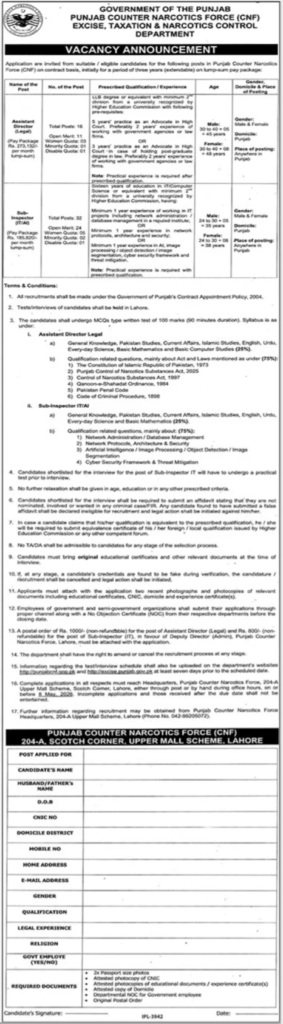
The Punjab Counter Narcotics Force (CNF) has officially announced multiple career opportunities for 2026 under the Excise, Taxation & Narcotics Control Department, Government of Punjab. This recruitment drive represents one of the most significant government job announcements in the security sector for the current year, offering positions ranging from Sub Inspector to Assistant Director levels. With the advertisement published in the daily Jang Newspaper on April 25, 2026, eligible candidates across Punjab now have a limited window to submit their applications before the expected closing date of May 8, 2026.
Working within the security jobs framework of the provincial government, these positions offer not only competitive remuneration but also the opportunity to contribute directly to Pakistan’s ongoing fight against narcotics trafficking and substance abuse. The Excise Taxation & Narcotics Control Department, headquartered at Upper Mall in Lahore, continues to expand its operational capacity by recruiting qualified professionals who can handle the technical, legal, and investigative demands of modern counter-narcotics operations.
Overview of Punjab CNF Recruitment 2026
The Punjab Counter Narcotics Force operates as a specialized unit under the Excise, Taxation & Narcotics Control Department, with its primary mandate focused on combating drug trafficking, preventing substance abuse, and enforcing narcotics laws across the province. The 2026 recruitment cycle specifically targets professionals who can strengthen the force’s capabilities in legal affairs, information technology, artificial intelligence applications, and general investigation.
According to the official vacancy announcement, applications are invited from suitable and eligible candidates for multiple posts in Punjab Counter Narcotics Force on a contract basis, initially for a specified period with the possibility of extension based on performance and departmental requirements. This contractual arrangement is standard practice for specialized government positions, allowing the department to assess candidate performance before offering permanent tenure.
The recruitment notice emphasizes that these positions fall under the broader category of government security jobs, requiring candidates to meet stringent educational and physical standards. The department particularly values candidates who demonstrate both academic excellence and practical skills relevant to counter-narcotics operations in the digital age.
Available Positions and Designations
The current recruitment drive encompasses several distinct roles, each tailored to specific operational needs within the Punjab CNF. The primary positions advertised include Sub Inspector, Assistant Director, Assistant Director Legal, Sub Inspector IT, and Sub Inspector AI. These designations reflect the department’s modernization efforts, incorporating technology-driven roles alongside traditional law enforcement positions.
The Sub Inspector positions form the backbone of field operations, with specialized variants focusing on information technology and artificial intelligence applications. These technical roles represent a significant evolution in how counter-narcotics forces operate, leveraging data analytics and digital surveillance to track trafficking networks and predict drug movement patterns. The inclusion of AI-specific positions demonstrates the Punjab government’s commitment to adopting cutting-edge technology in its law enforcement apparatus.
The Assistant Director and Assistant Director Legal positions cater to administrative and judicial aspects of counter-narcotics operations. The legal variant specifically requires expertise in criminal law and prosecution procedures, ensuring that cases built against narcotics offenders can withstand judicial scrutiny. These managerial-level positions offer career progression opportunities for experienced professionals seeking leadership roles within the security sector.
Educational Qualifications and Eligibility Requirements
The Excise Taxation & Narcotics Control Department has established clear educational benchmarks for each position category. The required qualifications span multiple disciplines, reflecting the diverse skill sets needed for comprehensive counter-narcotics operations. Candidates must possess degrees in LLB, MIT, Master level qualifications, MCS, or other relevant fields depending on the specific post they are applying for.
For the Sub Inspector IT and Sub Inspector AI positions, candidates with Master in Information Technology (MIT) or Master of Computer Science (MCS) backgrounds receive preference. These technical roles demand proficiency in database management, network security, digital forensics, and increasingly, machine learning algorithms capable of processing large datasets to identify trafficking patterns. The department specifically seeks candidates who can bridge the gap between traditional law enforcement and modern technological solutions.
The Assistant Director Legal position mandates an LLB degree as a fundamental requirement, with additional qualifications in criminal law or prosecution providing competitive advantages. This role involves drafting legal opinions, reviewing case files for prosecutorial sufficiency, and representing the department in various legal forums. Candidates must demonstrate thorough understanding of Pakistan’s narcotics control legislation, including the Control of Narcotic Substances Act and related provincial statutes.
General Sub Inspector positions accept broader educational backgrounds, though Master’s level qualifications remain preferred. The “Others” category in educational requirements accommodates professionals with specialized training in criminology, forensic science, psychology, or related fields that contribute to effective counter-narcotics work. All candidates must ensure their degrees are recognized by the Higher Education Commission of Pakistan and relevant professional bodies.
Age Limits, Experience, and Physical Standards
Beyond educational credentials, the Punjab CNF recruitment 2026 establishes specific age parameters for applicants. The general age bracket ranges from 24 to 45 years, though certain positions may have variations based on the level of seniority and experience required. These age limits ensure that recruits possess sufficient maturity for law enforcement responsibilities while maintaining the physical fitness standards necessary for field operations.
Experience requirements vary by position, with technical and legal roles demanding one to five years of relevant professional practice. The Assistant Director positions typically require more extensive experience compared to entry-level Sub Inspector roles. However, exceptional candidates with outstanding academic records may receive consideration even with limited practical experience, particularly for positions in emerging fields like artificial intelligence applications.
Physical standards for security jobs within the Counter Narcotics Force follow established government protocols. Candidates must meet minimum height, chest measurement, and visual acuity requirements. Physical endurance tests form part of the selection process, ensuring that personnel can handle the demanding nature of counter-narcotics field operations, which often involve extended surveillance, raids in challenging terrain, and high-stress confrontations with armed traffickers.
Application Process and Documentation
The Excise Taxation & Narcotics Control Department has streamlined its application process for the 2026 recruitment cycle, accepting submissions through both online and traditional channels. Candidates must obtain the official application form, available through the department’s career portal and designated government offices. The form requires comprehensive personal information, educational details, and professional experience documentation.
Required documentation includes attested copies of all educational certificates, a detailed curriculum vitae highlighting relevant experience, domicile certificates proving Punjab residency, and four recent passport-size photographs. Candidates must also provide their Computerized National Identity Card (CNIC) details and valid mobile contact numbers for communication throughout the selection process. Experience certificates from previous employers must be verified and attached for positions requiring prior professional practice.
The application submission process demands careful attention to deadlines, with the expected last date of May 8, 2026, serving as the firm cutoff for all submissions. Candidates are strongly advised to submit their applications well before this deadline to avoid any last-minute complications or postal delays. The department explicitly states that incomplete applications or those received after the deadline will not be entertained under any circumstances.
Selection Procedure and Testing Protocol
The Punjab CNF follows a rigorous multi-stage selection process designed to identify the most capable candidates for these sensitive security positions. The process typically commences with a written examination assessing general knowledge, analytical abilities, and subject-specific expertise relevant to the applied position. For technical roles, written tests incorporate sections on information technology, programming fundamentals, and data analysis techniques.
Following successful completion of written examinations, candidates proceed to physical efficiency tests measuring endurance, strength, and agility. These tests simulate real-world operational demands, ensuring that selected candidates can perform effectively in field conditions. The physical assessment phase eliminates candidates who, despite academic excellence, lack the physical capacity for law enforcement duties.
Interview panels comprising senior officials from the Excise Taxation & Narcotics Control Department and subject matter experts evaluate candidates who clear the written and physical stages. These interviews assess communication skills, problem-solving abilities, ethical judgment, and commitment to public service. For legal and technical positions, specialized interview components test domain-specific knowledge and practical application capabilities.
Final selection depends on cumulative performance across all assessment stages, with merit lists published on the official department website and notice boards. Selected candidates undergo comprehensive background verification before receiving appointment letters, ensuring that individuals entrusted with counter-narcotics responsibilities maintain impeccable personal and professional records.
Job Benefits and Career Progression
Positions within the Punjab Counter Narcotics Force offer comprehensive government employment benefits, including competitive salary packages aligned with provincial pay scales, medical coverage for employees and their immediate family members, and pension contributions ensuring financial security after retirement. The department also provides housing allowances for personnel posted outside their home districts and travel reimbursements for official duties.
During active duty assignments, the department ensures that food facility is available for personnel engaged in extended operations or posted at remote locations. This provision reflects the operational reality of counter-narcotics work, where officers may spend days or weeks in the field conducting surveillance and interdiction operations. Additional allowances compensate for the inherent risks and irregular hours associated with security jobs in narcotics enforcement.
Career progression within the Punjab CNF follows structured promotion pathways, with Sub Inspectors eligible for advancement to Inspector and eventually Superintendent positions based on performance, seniority, and additional qualifications. Assistant Directors can progress to Deputy Director and Director roles, assuming increasing administrative and strategic responsibilities. The department encourages continuous professional development, sponsoring training programs in advanced investigative techniques, leadership, and emerging technologies.
Strategic Importance of Counter Narcotics Operations in Punjab
Punjab’s geographic and demographic characteristics make it a critical battleground in Pakistan’s fight against narcotics trafficking. As the country’s most populous province with extensive international borders and major transportation corridors, Punjab faces significant challenges in preventing the transit and distribution of illegal substances. The Counter Narcotics Force serves as the primary provincial agency addressing these challenges, working in coordination with federal entities like the Anti-Narcotics Force and international partners.
The recruitment of technically skilled personnel through initiatives like the 2026 jobs announcement directly enhances the force’s operational effectiveness. Sub Inspector AI positions, for example, enable the department to deploy predictive analytics in identifying high-risk trafficking routes and suspicious transaction patterns. Similarly, IT specialists strengthen digital surveillance capabilities and cybersecurity measures protecting sensitive operational data.
The legal expertise brought in through Assistant Director Legal positions ensures that interdiction operations result in successful prosecutions, creating deterrent effects that discourage future trafficking attempts. This comprehensive approach—combining field enforcement, technological innovation, and legal precision—represents the modern paradigm in counter-narcotics strategy, positioning Punjab as a leader in provincial drug enforcement efforts.
Related Government Opportunities in Health and Law Enforcement Sectors
Professionals interested in public service careers beyond counter-narcotics enforcement should explore opportunities in related government sectors. The healthcare industry continues to expand its workforce, with institutions like Dr. Ruth Pfau Hospital offering house job positions for fresh MBBS doctors in 2026, providing essential clinical training for medical graduates beginning their professional journeys. These positions complement broader public health efforts, including substance abuse treatment and rehabilitation programs that work alongside enforcement initiatives.
For candidates drawn to law enforcement and correctional services, the Sindh Prison Department has announced constable recruitment for 2026, presenting parallel career paths in the criminal justice system. While operating in a different province, these positions share similar eligibility requirements and selection standards with Punjab CNF roles, offering alternatives for candidates who may face geographic constraints or competitive pressures in the Punjab recruitment process.
Both the health and prison sectors intersect meaningfully with counter-narcotics work. Medical professionals contribute to rehabilitation programs for substance abuse victims, while correctional officers manage offenders convicted under narcotics laws. Candidates successful in Punjab CNF recruitment may find future opportunities for inter-departmental collaboration and career transitions across these related public service domains.
Preparing a Competitive Application
Success in securing a Punjab CNF position requires more than meeting minimum eligibility criteria. Competitive candidates invest substantial effort in preparing applications that distinguish them from numerous applicants vying for limited positions. This preparation begins with thoroughly understanding the specific requirements for the desired post, ensuring that every claimed qualification aligns precisely with the advertised criteria.
Application forms demand accuracy and completeness, with any discrepancies between stated qualifications and verified documents resulting in immediate disqualification. Candidates should prepare comprehensive folders containing original documents and multiple sets of attested copies, organized logically to facilitate verification processes. Professional presentation of the curriculum vitae, highlighting relevant achievements and experience, creates positive impressions during document review stages.
Beyond paperwork, serious candidates begin physical conditioning well before application submission, recognizing that fitness standards represent non-negotiable requirements rather than aspirational goals. Regular cardiovascular training, strength building, and flexibility exercises prepare candidates for the physical efficiency tests that eliminate otherwise qualified applicants. Similarly, reviewing past examination patterns and current affairs relevant to narcotics enforcement enhances performance in written tests.
Conclusion
The Punjab Counter Narcotics Force Jobs 2026 represent exceptional opportunities for qualified professionals seeking meaningful careers in government security services. With positions spanning technical, legal, and operational domains, this recruitment drive welcomes diverse expertise united by common commitment to combating narcotics trafficking and protecting Punjab’s communities from substance abuse harms.
Prospective applicants must act decisively given the approaching deadline of May 8, 2026. Delaying application preparation risks missing this limited window for joining one of Punjab’s most critical law enforcement agencies. Candidates should verify all eligibility requirements against their qualifications, gather necessary documentation, and submit complete applications through designated channels well before the cutoff date.
For continuous updates on this recruitment and related government opportunities, monitor the official Excise, Taxation & Narcotics Control Department website and reputable job portals publishing verified public sector announcements. The fight against narcotics demands dedicated professionals, and the Punjab CNF offers the platform, resources, and mission for those ready to accept this challenging yet rewarding calling.