
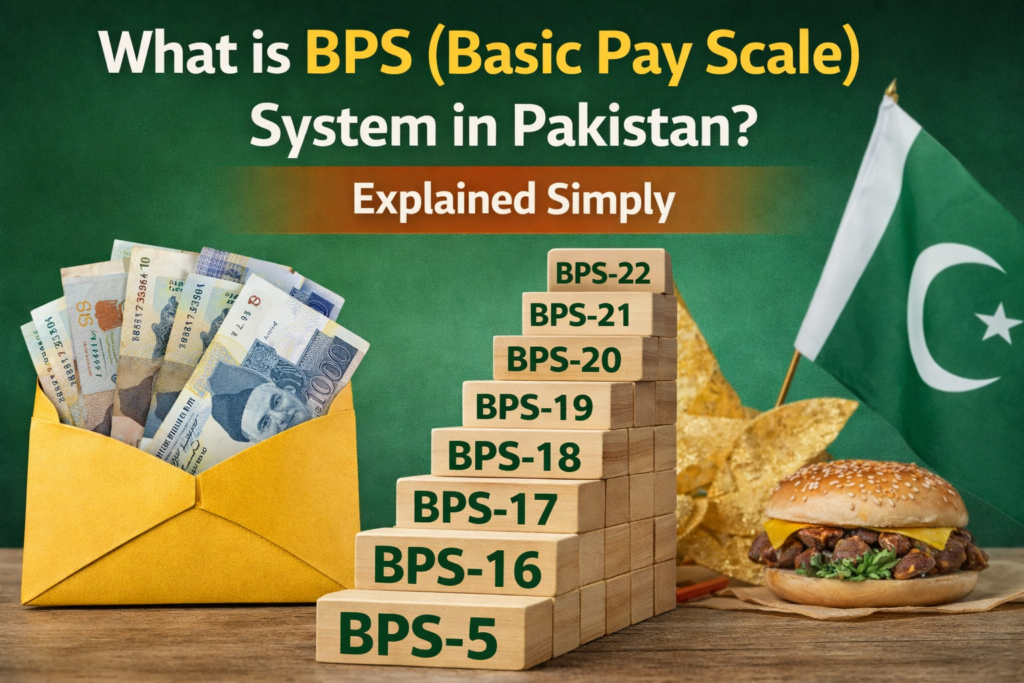
If you have ever searched for a government job in Pakistan, you have definitely come across terms like BPS-17, BPS-14, or BPS scale. But what exactly does BPS mean? Why do millions of aspirants dream of a position in the Basic Pay Scale system? This guide explains the entire BPS structure in plain, simple language — without jargon or fluff. Whether you are a fresh graduate, a working professional looking for stability, or someone who wants to understand how government salaries work, this pillar guide will give you real, actionable knowledge.
1. Why the BPS System Exists – The Story Behind It
Before 1973, government jobs in Pakistan had scattered, inconsistent pay structures. Some departments paid more for similar work, and promotions were often based on favoritism. To bring fairness, transparency, and uniformity, the government introduced the Basic Pay Scale (BPS) system under the 1973 Constitution (and later refined through pay commission reports).
The idea was simple: every post – from a clerk (BPS-7) to a secretary (BPS-22) – has a fixed scale. Your salary, increments, and pension all depend on that scale. This eliminated confusion and gave employees a clear growth path. Today, almost all federal and provincial government departments, autonomous bodies, and even some semi-government organizations follow BPS or a modified version of it.
2. How BPS Works – Breaking Down the Grades (1 to 22)
The BPS system has 22 grades. Each grade has a minimum and maximum basic salary, along with a running pay scale that increases every year through annual increments. Below is a simplified overview of the grades and typical positions:
| BPS Grade | Typical Job Titles / Roles | Minimum Basic Pay (Approx. PKR) |
|---|---|---|
| 1 to 4 | Naib Qasid, Chowkidar, Attendant, Sanitary Worker | 15,000 – 22,000 |
| 5 to 6 | Driver, Junior Clerk (initial), Dispatch Rider | 23,000 – 30,000 |
| 7 to 9 | Clerk, Data Entry Operator, Junior Technician | 32,000 – 42,000 |
| 10 to 12 | Assistant (BPS-12), Stenotypist, Sub-Engineer | 45,000 – 58,000 |
| 13 to 15 | Section Officer (BPS-15), Audit Officer, Inspector | 62,000 – 80,000 |
| 16 to 17 | Civil Officer (BPS-17), Assistant Director, Police DSP | 90,000 – 1,20,000+ |
| 18 to 19 | Deputy Secretary, Superintendent of Police (SSP), Professor | 1,40,000 – 2,00,000 |
| 20 to 22 | Joint Secretary, Additional Secretary, Federal Secretary | 2,50,000 – 5,00,000+ |
*Note: Basic pay changes every few years after pay commission recommendations. Allowances (house rent, utilities, medical) usually double or triple the in-hand salary.
3. Allowances and Perks – Why BPS Jobs Are So Desirable
The real attraction of BPS jobs is not just the basic salary; it’s the massive allowance structure. A BPS-17 officer might have a basic pay of ~45,000 PKR, but after adding house rent allowance (HRA), conveyance allowance, medical, and utilities, the take-home easily crosses 90,000–1,20,000 PKR. Higher grades get even larger ratios.
Other benefits include:
- Pension: After retirement, government employees receive a monthly pension calculated on last drawn basic pay.
- Medical coverage: Family healthcare in government hospitals and reimbursement for private treatment.
- Job security: A BPS employee cannot be fired without a proper inquiry — unheard of in the private sector.
- Annual increments: Each year, you move one step up in the same scale, increasing basic pay.
- Promotion paths: Time-scale promotions (e.g., BPS-17 to BPS-18 after 4–5 years) and departmental exams.
4. How Promotions Work in the BPS Hierarchy
Promotions happen in two ways:
- Time-scale promotion (automatic): After a certain number of years (usually 4–5) in a grade, an employee becomes eligible for the next grade, provided they have a clean record and basic training requirements.
- Selection/Departmental exam: For higher jumps (e.g., BPS-16 to BPS-17 or BPS-17 to BPS-18), a competitive exam or interview panel selects the best candidates. This ensures that only competent people reach leadership roles.
For example, a BPS-7 clerk can, over 25–30 years, rise to BPS-14 or BPS-15 through time-scale and limited departmental exams. But an officer recruited directly as BPS-17 (like through CSS) can reach BPS-20+ by age 50. Your entry grade decides your career ceiling.
5. BPS vs. Contract / SPPS – What’s the Difference?
In recent years, the government has introduced contractual positions and Special Professional Pay Scales (SPPS) for niche, time-bound roles. Unlike regular BPS, these positions often offer higher salaries but lack pension and long-term job security.
A perfect example is the Ministry of Information and Broadcasting Jobs 2026 — they advertised senior leadership roles like Head of Data and Head of Strategy on SPPS-II and SPPS-III. These pay scales mirror BPS-20 or BPS-21 salaries but are contract-based (usually 2–3 years, extendable). SPPS is meant to attract private-sector experts who wouldn’t join at lower BPS rates.
Key differences:
- Job security: BPS is permanent; SPPS/contract ends after tenure.
- Pension: BPS gets a lifetime pension; contract employees mostly get a lump-sum gratuity (if any).
- Salary: SPPS often pays higher monthly cash but fewer long-term benefits.
- Promotion: BPS has structured promotions; SPPS roles are fixed-term without automatic upgrades.
If you value stability and retirement benefits, target regular BPS recruitment. If you want high income and policy-level exposure for a few years, SPPS roles (like those in the Ministry of Information and Broadcasting) can be attractive. But for long-term career civil servants, nothing beats the traditional BPS system.
6. Real-Life Examples: PAFDA and High-Paying Contract Roles
Sometimes, you’ll see government jobs offering salaries like Rs. 725,000 per month — far above typical BPS scales. For instance, the Punjab Agriculture Food & Drug Authority (PAFDA) Jobs 2026 advertised senior technical manager positions with monthly pay up to Rs. 775,000. Are these BPS positions? Usually not. Such roles are often contractual or on market-based salaries to attract top talent in specialized fields (lab management, IT, quality assurance).
These jobs do not follow the traditional BPS increment or pension system. However, they still operate under government rules and offer prestigious experience. When you see such high figures, understand that you’re likely looking at a time-bound, project-based role — excellent for mid-career professionals, but not the same as a lifelong BPS career. For details on eligibility and the application process for such specialized roles, check the complete PAFDA Jobs 2026 guide.
7. How to Prepare for BPS Job Written Tests (Critical for Entry)
Landing any BPS job (from BPS-7 to BPS-17) requires passing a written test conducted by FPSC, PPSC, NTS, or department-specific bodies. These tests evaluate general knowledge, English, mathematics, current affairs, and subject-specific expertise. The competition is fierce — often thousands of applicants for a single BPS-14 slot.
Smart candidates don’t rely on guesswork. They follow structured preparation, practice past papers, and master time management. For a complete roadmap — including syllabus breakdown, daily study plans, and mistakes to avoid — read our detailed guide: How to Prepare for Written Tests for Government Jobs. That resource covers everything from analyzing the job advertisement to test-day strategies.
Remember: your BPS journey starts with the written exam. Without a strong score, you won’t even reach the interview panel.
8. Common Myths About the BPS System (Busted)
Myth 1: “Higher BPS always means more work.” Not necessarily. A BPS-20 secretary might work 12 hours, but a BPS-11 assistant can also have heavy loads. Work depends on department and role.
Myth 2: “Only CSS officers get BPS-17 and above.” False. Many professional posts (engineers, doctors, IT officers) are recruited directly in BPS-17 by PPSC/FPSC. CSS is one route, but not the only one.
Myth 3: “BPS employees can’t be fired.” While job security is high, serious misconduct or corruption can lead to dismissal after a due process. It’s not a free pass.
Myth 4: “You can’t move from BPS-1 to BPS-20.” It’s rare, but possible through exceptional performance and qualifying promotional exams. Some police officers start as ASI (BPS-9) and retire as SSP (BPS-19).
9. Pros and Cons of a BPS Career (Honest Assessment)
✅ Advantages:
- Unmatched job security and pension
- Respect and social status
- Structured promotions and annual increments
- Healthcare and housing allowances
- Loan eligibility from banks (government employees get preferential rates)
⚠️ Disadvantages:
- Slow initial salary growth compared to top private jobs
- Bureaucracy and red tape
- Transfer policies (can be posted anywhere)
- Limited merit-based fast-track options
For many, the stability outweighs the drawbacks. That’s why lakhs of applicants compete for every BPS vacancy.
10. Step-by-Step Guide to Entering the BPS System
If you are serious about a BPS career, follow this roadmap:
- Choose your target grade – For graduates: BPS-16 (Assistant), BPS-17 (Officer), or technical BPS-17 (Engineer/Doctor).
- Monitor job ads – Regularly visit PPSC, FPSC, NTS, and departmental websites. Or follow platforms like AlfJobz for updated listings.
- Prepare for the written test – Use past papers, syllabus, and our written test guide.
- Clear the interview panel – Government panels assess confidence, knowledge, and body language.
- Complete document verification – Degrees, CNIC, domicile, experience certificates.
- Medical and final appointment – Once your name appears on the merit list, you receive an offer letter.
11. Future of BPS – Will It Change?
In recent years, there have been talks of replacing BPS with a more flexible “performance-based” pay system. However, strong political and employee opposition has kept BPS intact. The government has instead introduced parallel systems like SPPS and contract hiring for specific needs. For the foreseeable future (next 10–15 years), BPS will remain the core pay structure for the majority of Pakistan’s civil service. So, understanding it is still essential.
Conclusion: Your BPS Journey Starts Now
The Basic Pay Scale system is the lifeblood of government employment in Pakistan. It brings order, fairness, and a clear path for millions of employees. From the lowest grade to the highest, every role has dignity and structure. If you are an aspirant, don’t get overwhelmed by competition. Instead, use the resources available: study past papers, learn from real job examples like Ministry of Information & Broadcasting SPPS roles or PAFDA technical positions to understand the market, and most importantly, master the written test preparation — because without clearing the exam, the BPS door remains closed.
Now that you know what BPS truly means, take the next step. Choose your grade, start preparing, and build the government career you deserve.