
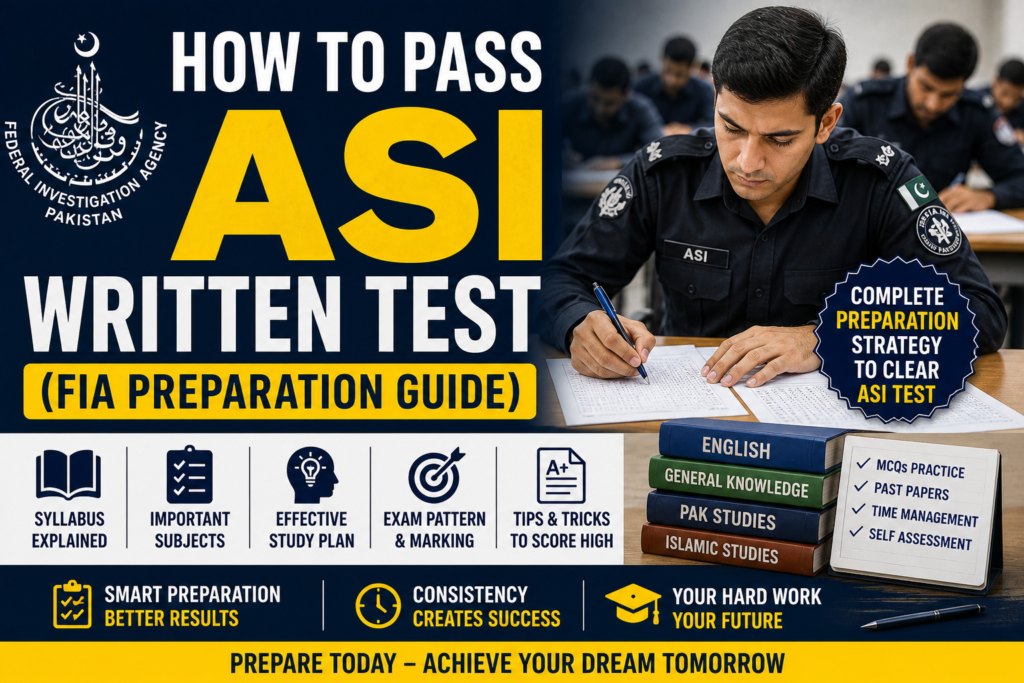
Clearing the Assistant Sub-Inspector written exam is about strategy as much as it is about knowledge. The FIA doesn’t just test what you memorised in university — it evaluates how quickly you can think, how sharp your general awareness is, and whether you have the basic computer and reasoning skills needed for field investigation work. Every year, graduates with strong degrees walk into the test centre overconfident and walk out wondering what went wrong. The ones who succeed are those who understand the exam pattern deeply and prepare for it like a competitive race. This guide breaks down exactly what you need to study, how to structure your weeks, which resources actually help, and what pitfalls to avoid. If you’ve already cleared the FIA Physical Test Requirements — Height, Chest, Running Guide, the written stage is where you can pull ahead of hundreds of other candidates with disciplined preparation.
Why the Written Test Feels Harder Than It Looks
On paper, an ASI exam covering English, General Knowledge, Pakistan Studies, Islamic Studies, Computer, and IQ doesn’t sound intimidating. The challenge comes from two things: the sheer breadth of topics and the stopwatch. You’ll face 80 to 100 multiple-choice questions in 90 minutes. That leaves roughly 54 seconds per question if the count is 100. There is no negative marking, which is a blessing, but time pressure alone can cause you to freeze on questions you’d otherwise answer easily. The test is conducted as a computer-based test in English, so if your reading speed is slow, that’s another layer you need to work on. Knowing the syllabus is step one; practicing under timed conditions is what actually earns you the passing score.
ASI Test Pattern at a Glance
Before you open a single book, you need to internalize the format. The FIA ASI paper is a 100-mark Computer-Based Test consisting entirely of multiple-choice questions. The typical time allowance is 90 minutes, although some cycles have seen 60-minute versions for lower-scale posts — ASI falls on the longer end. There is no negative marking, so guessing is free, but random guessing without logic won’t improve your score much. The distribution of subjects is roughly as follows: English 20%, General Knowledge 20%, Computer 20%, IQ and Analytical Reasoning 20%, Pakistan Studies 10%, and Islamic Studies or Ethics 10%. The exact weightings can shift slightly, but this distribution holds true for most recent cycles, including the 2026 recruitment that is covered in detail on the main FIA Announced Multiple Vacancies page.
Subject-by-Subject Breakdown and How to Prepare
English — 20% of the Paper
This section tests vocabulary, grammar, sentence correction, and reading comprehension. You’ll see synonym and antonym pairs, fill-in-the-blank grammar questions, and short paragraphs followed by inference-based questions. The difficulty is intermediate — harder than Matric but easier than a competitive CSS exam. Your best preparation tool is a solid grammar book combined with daily vocabulary practice. Spend fifteen minutes every morning learning ten new words with their synonyms and antonyms. Revisit words from previous days regularly. For grammar, focus on tenses, subject-verb agreement, prepositions, and active-passive voice. When practicing comprehension, read the questions first, then scan the passage — it saves precious seconds.
General Knowledge — 20% of the Paper
This is where most candidates lose easy marks because they haven’t kept up with current affairs. The GK section blends static knowledge — like capital cities, Nobel Prize winners, and major world organisations — with events from the last 12 to 18 months. For the 2026 test, you must know what happened in Pakistan politically, economically, and in sports from January 2025 onward. The budget, key legislation, visits by foreign dignitaries, and major international conflicts all feature. Bookmark a reliable daily news source, read the headlines for ten minutes daily, and keep a notebook where you jot down facts. At the end of each week, quiz yourself from that notebook. Static GK can be covered from any reputable general knowledge book; the current affairs part depends entirely on your daily news habit.
Computer Awareness — 20% of the Paper
Many humanities graduates get nervous here, but the truth is that the FIA doesn’t expect you to be a programmer. Questions revolve around MS Office (Word, Excel, PowerPoint), basic hardware and software concepts, internet terminology, and elementary cybersecurity. You should know shortcuts like Ctrl+C, Ctrl+V, Ctrl+P, what a CPU is, the difference between RAM and ROM, and terms like phishing, malware, and firewall. If you’ve used a computer for university assignments, you already know half of this. Spend a few hours with any basic computer book that covers the NTS or FPSC pattern, and you’ll be well-prepared. Practice by working with Word and Excel, not just reading about them.
IQ and Analytical Reasoning — 20% of the Paper
This section measures how you think, not what you know. Number series, letter patterns, analogies, logical deductions, and basic arithmetic problems make up the bulk. The good thing is that IQ improves with practice — your brain literally gets faster at recognising patterns the more you expose it to them. Start with simple number sequences and gradually move to more complex ones. Analogies test your ability to see relationships; practice these daily. For arithmetic, revise percentages, ratios, averages, and simple interest. The math is high school level, but the trick is solving it mentally or with minimal scribbling since you’re on a computer terminal.
Pakistan Studies — 10% of the Paper
Questions cover the Pakistan Movement, constitutional developments, major historical events, provincial geography, and key national institutions. The Indus Valley civilisation, the 1973 Constitution, the passing of major amendments, and the country’s physical features are regular topics. A standard intermediate-level Pakistan Studies textbook is usually enough. Focus on understanding the chronology of events rather than memorising isolated dates. When you know the sequence of constitutional milestones, you can often deduce an answer even if the exact date escapes you.
Islamic Studies or Ethics — 10% of the Paper
Muslim candidates are tested on fundamental Islamic teachings: the pillars of Islam, key events from the life of the Prophet (PBUH), the early Caliphate, and basic Quranic knowledge. Non-Muslim candidates receive an ethics paper that covers moral philosophy, honesty, civic responsibility, and basic ethical reasoning. For Islamic Studies, an intermediate-level textbook or a concise guide like the one by Zahid Hussain Anjum works well. Don’t overcomplicate this section; the questions are straightforward and factual.
A Four-Week Study Plan That Actually Works
Week 1 — Foundation and Weakness Diagnosis: Begin by taking a full-length mock test without any preparation. This is painful but essential — it shows you exactly where you stand. Analyse the result. If you scored well in English but poorly in Computer, that tells you where to spend your energy. For the rest of the week, focus on English and IQ, doing 30 minutes of each daily. Start the vocabulary notebook and solve 20 reasoning questions every evening.
Week 2 — GK and Pakistan Studies Push: These two subjects reward consistent exposure rather than cramming. Spend this week reading current affairs summaries from the last year and revising Pakistan Studies. Create a timeline of major events. Keep practicing English and IQ for 20 minutes each to stay sharp. By the end of this week, you should have covered the static portion of GK and the entire Pakistan Studies syllabus once.
Week 3 — Computer and Islamic Studies/Ethics: Computer awareness can be covered in a few focused days if you use a good MCQ bank. Go through MS Office functions, hardware basics, and internet terms. For Islamic Studies, read through the key topics and solve MCQs to reinforce. This is also the week you start mixing subjects — one day do English and Computer, the next day IQ and GK, so your brain becomes comfortable switching between different types of thinking.
Week 4 — Full Mock Tests Under Time Pressure: This is the most important stage. Take at least four full-length tests under exam conditions: 100 questions, 90 minutes, no distractions, no pausing. After each test, review every wrong answer. Understand why you got it wrong. Was it a knowledge gap, a time pressure error, or a careless misreading? Adjust accordingly. By the fourth mock test, your timing should feel natural. You’ll know when to skip a tough question and when to spend an extra ten seconds.
Best Resources for ASI Test Preparation
You don’t need expensive coaching or a stack of books. The best free resources include online platforms like ExamChamber, GoTest, and TestPoint, which have extensive FIA-style MCQ banks. For current affairs, a daily scroll through Dawn’s headlines and a weekly review of a current affairs digest is sufficient. For English, any grammar book by Wren and Martin or a local equivalent works. For Pakistan Studies, the textbook you used in Intermediate is usually the most reliable. The one paid resource that can be worth it is a past paper compilation book specific to FIA and FPSC exams, available at any major bookshop in Urdu Bazaar or online. If you’re also considering other uniformed positions, the Constable Jobs 2026 Pakistan Apply Online page offers a wider view of the recruitment landscape across different pay scales.
Time Management Inside the Exam Hall
When the screen loads with the first question, you’ll feel a surge of adrenaline. Use it, but don’t let it rush you. Spend the first ten seconds scanning the entire section to see how many questions there are. Divide your time: if there are 100 questions and 90 minutes, allocate roughly 50 seconds per question. Questions you find easy — a straightforward synonym or a basic arithmetic problem — should take less than 30 seconds. The saved time goes to tougher analytical reasoning questions that might need a full minute.
Never linger on a single question for more than two minutes. If you’re stuck, mark it for review and move on. You can return to flagged questions at the end. Most importantly, answer every single question. With no negative marking, leaving a question blank is leaving a free mark on the table. Even a blind guess has a 25% chance of being correct on a four-option MCQ.
Common Mistakes That Cost You Marks
The most damaging habit is spending excessive time on the first ten questions, trying to answer them perfectly. This leaves you rushing through the last thirty questions where easier marks often sit. Another frequent error is ignoring the computer section until the last few days. It’s 20% of your score, and the material is simple — neglect it, and you give away a chunk of the paper to candidates who spent just a few hours on it. Some candidates rely entirely on reading and never practice solving MCQs under a timer. Reading is passive; solving is active. You must do both. Finally, poor sleep the night before can undo four weeks of hard work. A tired brain processes information slower. The night before the test, stop studying by 8 PM, eat a light dinner, and go to bed early.
What Comes After the Written Test
Once you’ve passed the written exam, your name appears on the shortlist for the interview. This is the psychological evaluation stage, where a panel assesses your personality, communication skills, and suitability for the FIA. The interview is a separate challenge entirely, but knowing that you’ve aced the written portion gives you a powerful confidence boost heading into it. Keep all your original documents ready, including degrees, CNIC, domicile, and the roll number slip from the physical test. If you need to revisit the physical fitness benchmarks that started this entire journey, the FIA Physical Test Requirements Guide remains available for reference, especially if you plan to apply again in a future cycle.
Frequently Asked Questions
Q: Is the ASI written test conducted in English or Urdu?
A: The test is conducted entirely in English. However, the difficulty level of the English used is intermediate, not highly advanced. A solid understanding of vocabulary and grammar is sufficient.
Q: Can I use a calculator during the test?
A: No. The computer-based test system does not provide an on-screen calculator for arithmetic questions. You must solve mathematical problems mentally or with rough work if permitted. Practice mental math during preparation.
Q: Are past papers available for FIA ASI tests?
A: Yes, many past papers and model papers are available online on platforms like TestPoint and ExamChamber, as well as in printed compilations. Solving at least five past papers is a proven preparation strategy.
Q: How many months of current affairs should I cover?
A: Focus on the 12 to 18 months preceding your test date. For the 2026 cycle, that means from roughly January 2025 to the present. Pay extra attention to Pakistan-specific developments.
Q: Is the ASI test the same as the Constable test?
A: The subject areas are similar, but the ASI test is more challenging. Expect deeper reading comprehension, more complex reasoning problems, and higher-level computer concepts. The basic format and time pressure, however, are comparable across both.
Your Path to an ASI Uniform Starts With This Test
The written exam is where your academic foundation meets your preparation discipline. It rewards consistent, calm effort far more than last-minute panic. Start today — open a vocabulary list, bookmark a news site, and solve ten IQ questions. Build the habit, trust the four-week plan, and walk into that test centre knowing you’ve done the work that others postpone. The FIA doesn’t need geniuses; it needs officers who prepare thoroughly and think clearly under pressure. Show them you are one of those.