
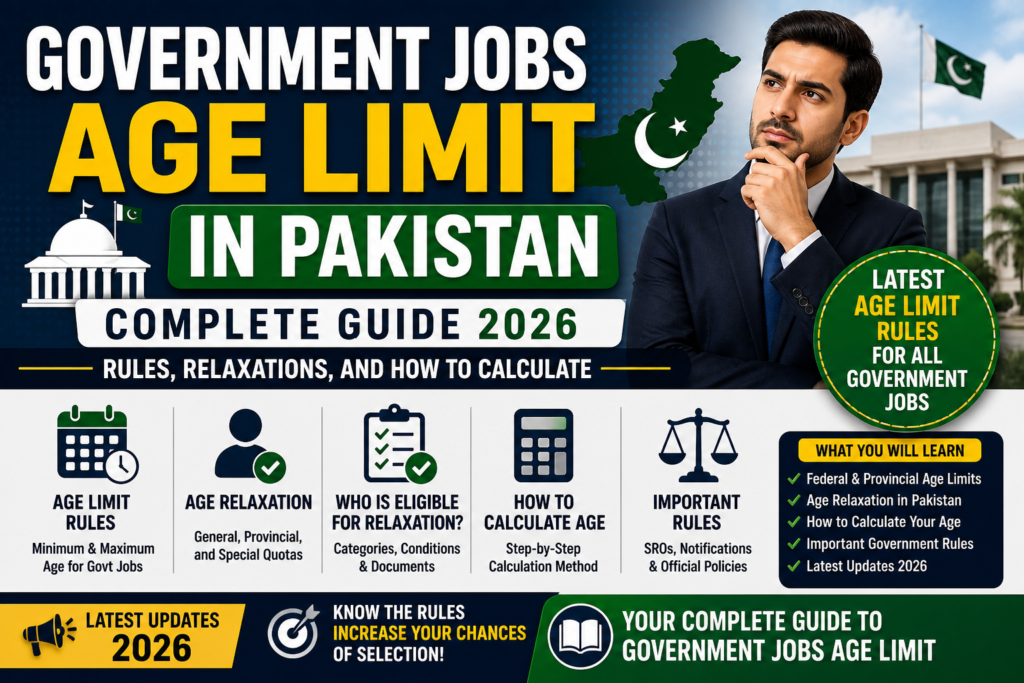
Every government job advertisement in Pakistan contains one line that decides whether you can even apply: the age limit. It’s the first filter, and it’s non-negotiable unless you fall under a recognized relaxation category. Yet the rules around age limits are scattered across federal and provincial service laws, SROs, and individual department policies, making them confusing for the average applicant. This guide brings all that information into one place. Whether you are aiming for an FPSC post, a police constable position, an ASI role in FIA, or a teaching job under a provincial education department, the age framework explained here will help you quickly determine your eligibility. And because the physical and written tests are the next hurdles after the age check, you’ll find practical links to guides on the FIA physical test requirements and the ASI written test preparation so you can continue preparing once you confirm your age eligibility.
Why Age Limits Exist in Government Recruitment
Age limits are not arbitrary. They serve a structural purpose. Governments need a workforce that can serve for a reasonable period before retirement, which is typically 60 years. If a candidate joins at age 50, the state invests in training and salary for only a decade of service. Thus, entry age is capped to ensure a full career span. Additionally, uniformed services like police and the FIA demand physical fitness that naturally correlates with age. A 40-year-old, however mentally sharp, may struggle to meet the same endurance standards as a 25-year-old. These physical demands are detailed in the police jobs running time guide, which explains exactly what your body must deliver. Age limits, therefore, are both an administrative tool and a practical selection mechanism.
General Age Limit Rules Across Pakistan
The baseline age limit for most federal government posts, including those advertised through the Federal Public Service Commission (FPSC), is 18 to 30 years. Provincial civil service posts follow a similar bracket: Punjab and Sindh typically set the limit at 18 to 30 years for general category candidates. Khyber Pakhtunkhwa and Balochistan sometimes extend the upper bound to 32 or even 35 years for local domicile holders under specific relaxation policies. For uniformed positions, the upper limit often drops because of physical fitness requirements. For example, a Police Constable or an ASI in the FIA will usually see an age bracket of 18 to 25 years, with relaxations applied separately. Always read the specific advertisement, but keep the 18–30 baseline in mind as the starting reference point.
Complete Age Relaxation Rules – Who Gets Extra Years
This is the section that can make an apparently ineligible application suddenly viable. Age relaxation is granted by the federal government through Establishment Division OMs and is adopted by provincial governments with occasional modifications. The standard relaxation package is as follows:
General Upper Age Relaxation – 5 Years
The most common and widely applicable relaxation: every candidate, regardless of category, receives an additional 5 years over the stated upper age limit in the advertisement. If a post says “maximum age 25 years,” you can effectively apply up to 30 years of age. This relaxation was permanently enhanced from 3 to 5 years through Establishment Division OM No. 1/1/2014-R-5 dated 09-11-2017. It applies to all federal posts, and most provinces have adopted the same policy. This single rule opens the door for thousands of candidates who would otherwise be over-age.
Government Servants – Up to 10 Years
Candidates already serving in a government department (federal or provincial) who apply for another government post are eligible for a relaxation of up to 10 years in the upper age limit, provided they have a minimum of two years of continuous service. This benefit is cumulative with the general 5-year relaxation, so an in-service 38-year-old government employee could still apply for a post with a 25-year upper age limit, if all conditions are met. The logic is that the state has already invested in their training and should not lose experienced personnel who wish to move laterally or progress.
Scheduled Castes, Buddhist Community, and Recognized Tribes
Candidates belonging to Scheduled Castes or the Buddhist community are eligible for an additional 3 years of relaxation beyond the general 5 years, bringing the total to 8 years over the advertised limit. Similarly, candidates from recognized tribes and areas declared as backward by the respective provincial government may receive a 3-year relaxation. In Balochistan and certain districts of KP, these relaxations are even more generous under provincial quota rules.
Widows, Divorced Women, and Women Candidates
Widows and divorced women (who have not remarried) are granted an upper age relaxation of 10 years over the advertised limit. This recognizes the particular difficulty these candidates face in re-entering the workforce. Many provinces extend a blanket 5-year relaxation to all female candidates, and when combined with the widow/divorced provision, some women can qualify even in their early forties for posts with a 25-year stated maximum.
Persons with Disabilities
Disabled candidates holding a certificate from a recognized assessment board are entitled to 10 years of age relaxation. The disability quota itself is usually 2% of total seats, and this relaxation ensures that the age barrier does not compound the barriers already faced by disabled persons.
Ex-FATA and Underprivileged Areas
Candidates from the erstwhile FATA region and other notified underprivileged or remote areas often receive an additional 3 to 5 years of relaxation, depending on the specific post and the department’s adoption of the federal OM. This is separate from the general 5-year relaxation. If you hold domicile from a federally or provincially recognized backward area, always check the advertisement for a specific note on territorial relaxation.
Armed Forces Retirees
Ex-servicemen and retired armed forces personnel applying for civil posts are eligible for age relaxation equal to the number of years they served in the military, up to a maximum of 15 years. This is over and above the general relaxation, making it possible for a retired Naib Subedar to enter a civilian government job well into his forties.
How to Calculate Your Age Correctly for Government Jobs
The calculation method is uniform across all federal and provincial departments: age is counted on the closing date of the application advertisement. If the advertisement states the last date to apply is 15 June 2026, your age as of 15 June 2026 is what matters. Count from your date of birth as recorded on your CNIC. If your CNIC shows 10 August 1998 as your date of birth, your age on 15 June 2026 will be 27 years, 10 months, and 5 days. The months and days are usually ignored — only completed years count. So you would be considered 27 years old. If you reach the maximum permissible age after the closing date but before the test or interview, you are still eligible. The snapshot is taken on the closing date only.
Age Limits for Popular Government Department Jobs
Police Department – Constable, ASI, Head Constable
Police jobs across Punjab, Sindh, KP, and Balochistan typically set a baseline age limit of 18 to 25 years for Constable and ASI positions. With the general 5-year relaxation, the effective maximum becomes 30 years. However, this baseline varies slightly: the Sindh Police has been known to allow a 28-year upper limit for general candidates with relaxation extending to 33 in certain recruitment cycles. The physical test is a major component of police recruitment, and it demands a level of fitness that becomes harder to maintain as you age. If you are within the upper band of eligibility, preparing for the physical test early is even more crucial. The complete police running time guide provides a practical training plan for candidates across all age groups.
FIA – ASI, Constable, Sub-Inspector
The Federal Investigation Agency, recruiting through the NPF portal for the 2026 cycle, maintains a baseline of 18 to 25 years for uniformed posts. The 5-year general relaxation applies, making 30 the practical upper limit for fresh applicants. In-service government employees applying for FIA posts can avail up to 10 years of relaxation. If you are targeting a role like Assistant Sub-Inspector, your next challenge after the age and physical filters will be the written test, and the ASI written test preparation guide is the resource designed to take you through that stage methodically. Physical test benchmarks — height, chest, and the 1.6-kilometre run — are non-negotiable, and the detailed FIA physical test requirements guide outlines every standard you need to meet.
FPSC – Federal Government Posts (BS-16 and Above)
The FPSC generally adheres to a 21 to 30 years age limit for most occupational groups, including Customs, Inland Revenue, and Pakistan Administrative Service. The 5-year general relaxation extends the maximum to 35. Some technical posts like medical officers or specialist positions may have higher age limits, typically up to 35 or 40 years, recognizing the additional years spent acquiring professional qualifications. FPSC advertisements clearly mention the age limit for each post, and because these are gazetted officer positions, the relaxation rules are strictly applied.
Provincial Public Service Commissions
PPSC (Punjab) commonly sets an upper age limit of 30 years for general candidates, with 5-year general relaxation bringing it to 35. KPSC (Khyber Pakhtunkhwa) has a wider bracket of 21 to 32 years for general candidates, plus the 5-year relaxation. BPSC (Balochistan) often allows up to 35 years for general candidates from Balochistan, with further relaxations for backward areas. Always cross-reference the specific advertisement with your domicile, as provincial commissions attach different limits based on regional quotas.
Armed Forces – Army, Navy, Air Force
Military recruitment follows its own strict age brackets that do not generally benefit from the federal 5-year relaxation. For the Pakistan Army’s PMA Long Course, the age bracket is 17 to 22 years, with a one-year relaxation for candidates who have already completed two years of graduation. Soldier recruitment (Sipahi) typically allows 17½ to 23 years for civilians and up to 25 years for those already serving as soldiers. The Navy and Air Force have similar brackets with minor variations. The military calculates age from the date of enrollment, not the application closing date, and there is no general relaxation beyond what is specifically mentioned in each branch’s advertisement.
Teaching Jobs – School, College, University
Teaching positions follow the same federal or provincial age rules. A Primary School Teacher (PST) or Elementary School Teacher (EST) post usually has an age limit of 18 to 30 years, with the standard 5-year relaxation. College lecturer posts through FPSC or provincial commissions typically maintain the 21 to 30 bracket. University positions — assistant professor and above — often have higher or no upper age limits, especially when filled on a contract or tenure track basis, because the focus shifts to qualifications and publications rather than age.
Common Documentation and Representation Errors
One recurring issue is a mismatch between the date of birth on the CNIC and the date on educational certificates. The CNIC date is considered the final authority. If your matric certificate shows a different date, the CNIC date will override it. If your re matric certificate is the base document used to issue your CNIC, but a discrepancy arose later, you must get it corrected through NADRA before applying. Submitting an application with contradictory dates of birth leads to disqualification and, in some cases, a charge of misrepresentation.
Another mistake is misinterpreting the relaxation as automatic. Age relaxation is not applied unless you explicitly claim it in your application form and provide the required proof. If you are applying under the government servant category, attach your service certificate and NOC. If you are a widow or disabled, attach the relevant certificate. Simply being eligible for a relaxation does not guarantee it will be considered; you must declare and prove it.
Frequently Asked Questions
Q: Does the general 5-year age relaxation apply to all government jobs?
A: Yes, it applies to all federal government posts and most provincial posts. However, uniformed services like the military and some autonomous bodies may have specific exemptions. Always check the advertisement for the phrase “general age relaxation as per federal government rules.”
Q: If I turn 30 the day after the closing date, am I still eligible for a post with a 30-year upper limit?
A: Yes. Age is calculated as of the closing date only. If on the closing date you are 29, you are eligible even if your birthday is the very next day.
Q: Can age relaxations be combined?
A: Yes, in many cases. For example, a disabled government servant can potentially claim the 5-year general relaxation, the 10-year service relaxation, and the 10-year disability relaxation, though administrative practice often caps the cumulative relaxation to a reasonable limit to prevent abuse.
Q: Is the age limit the same for male and female candidates?
A: The baseline advertisement age limit is usually the same, but women often benefit from additional relaxations on top. Some provincial policies grant a blanket 5-year relaxation to women, which stacks with the general relaxation.
Q: Where can I find the official notification for age relaxation in Pakistan?
A: The Establishment Division, Government of Pakistan, publishes all age relaxation OMs. The most commonly cited is OM No. 1/1/2014-R-5 dated 09-11-2017, which raised the general relaxation from 3 to 5 years. Other OMs cover specific categories like government servants, widows, and disabled persons.
Your First Step: Check the Closing Date, Then Your CNIC
Age limits can feel like an unfair barrier, especially when you are just a few months over the cut-off. But the relaxation framework is designed to be generous enough that most capable candidates find a legal path in. Your task is simple: note the closing date, look at your CNIC, count the years, and then check which relaxation categories you legitimately qualify for. If the math works, apply with confidence. If it does not, wait for the next cycle and use the time to prepare — whether that means getting physically ready for the run, or drilling the written test syllabus so you are unbeatable when your window reopens.