
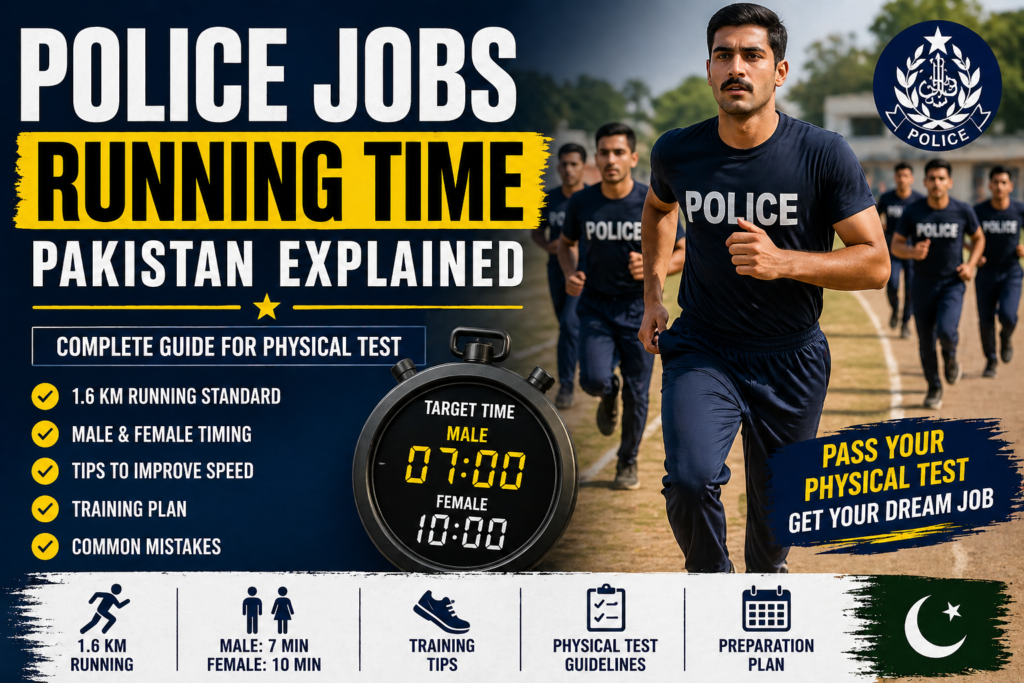
If you are planning to apply for police jobs in Pakistan, one of the biggest challenges is passing the physical test — especially the running test. Many candidates focus only on written exams but fail in the physical stage simply because they don’t understand the exact running requirements.
This guide clearly explains the running time standards for police jobs in Pakistan, including Constable, ASI, and other positions. You’ll also learn how to prepare, avoid common mistakes, and improve your chances of passing on the first attempt.
Why Running Test is Important in Police Recruitment
The running test is not just a formality. It is used to measure your physical fitness, stamina, and discipline. Police departments require candidates who can handle field duties, emergencies, and physically demanding situations.
Failing the running test means immediate disqualification, no matter how strong your academic background is. That’s why understanding the required time and preparing properly is essential.
Standard Running Requirements in Pakistan Police Jobs
The running requirement varies slightly depending on the department and role, but the general standard across most provinces is:
- Male Candidates: 1.6 km (1 mile) in 7 minutes
- Female Candidates: 1.6 km (1 mile) in 10 minutes
This standard is commonly used in:
- Punjab Police
- Sindh Police
- KPK Police
- Islamabad Police
Some departments may allow slight variation, but you should always prepare for the strictest version.
Running Test for Different Positions
Constable Running Requirement
For constable positions, the running test is the first physical step. Candidates must complete 1.6 km within the given time limit. If you are applying for roles like:
👉 Constable Jobs in Sindh Jail Department
you should expect the same running criteria.
Assistant Sub Inspector (ASI) Running Requirement
For ASI positions, the running requirement is usually the same but competition is tougher. Candidates are expected to perform better physically.
Even if the time requirement is similar, selection depends on overall fitness.
Ground Reality: Why Most Candidates Fail
Many candidates fail not because the test is difficult, but because they are unprepared. Here are the real reasons:
- They don’t practice running regularly
- They underestimate the time limit
- Poor stamina and breathing control
- Wrong running technique
- No warm-up before test
The biggest mistake is thinking “I will manage on test day.” That almost never works.
How to Prepare for Police Running Test (Step-by-Step)
1. Start with Short Distance
Don’t try 1.6 km on day one. Start with 400–800 meters and gradually increase.
2. Build Stamina First
Focus on consistency, not speed. Run daily for 7–10 days to build base stamina.
3. Practice Time-Based Running
Once comfortable, start timing yourself. Aim to reduce time gradually.
4. Use Interval Training
Run fast for 1 minute, then walk for 1 minute. Repeat 5–6 times. This improves endurance.
5. Focus on Breathing
Inhale through nose, exhale through mouth. Poor breathing is a major reason for failure.
6. Wear Proper Shoes
Running in poor shoes can slow you down and cause injury.
7. Stay Consistent
Even 15–20 minutes daily practice can make a big difference.
Ideal Weekly Training Plan
Here’s a simple plan:
- Day 1–2: Light running (500–800m)
- Day 3–4: 1 km running + walking
- Day 5–6: Full 1.6 km attempt
- Day 7: Rest or light jog
Repeat this cycle and track your timing.
Target Timing Strategy
To pass 1.6 km in 7 minutes:
- 400m → 1 minute 45 seconds
- 800m → 3 minutes 30 seconds
- 1.2 km → 5 minutes 15 seconds
- 1.6 km → under 7 minutes
Break your run into segments instead of thinking about full distance.
Common Mistakes You Must Avoid
- Starting too fast and getting exhausted
- Skipping warm-up
- Running on full stomach
- Not drinking enough water
- Practicing only 1–2 days before test
These small mistakes can cost you your selection.
What Happens on Test Day?
On test day, candidates are usually tested in groups. You will:
- Be lined up on ground
- Given instructions by officials
- Start running together or in batches
- Time will be strictly monitored
There is no second chance. If you fail, you are out.
Tips to Perform Better on Test Day
- Sleep well the night before
- Eat light (banana, water)
- Reach early to avoid stress
- Do proper warm-up
- Stay calm and focused
Is Running Test Difficult?
For an untrained person — yes.
For someone who practiced for 2–3 weeks — manageable.
The test is designed to filter out unprepared candidates, not to eliminate everyone.
Final Advice
If you are serious about joining police, start preparing for the running test today. Don’t wait for the test date announcement.
Combine your physical preparation with job updates and apply on time. You can explore latest openings and opportunities through:
👉 Latest Government Jobs on Alfjobz
Consistency is the key. Even average candidates pass when they prepare properly, while confident candidates fail when they ignore practice.
Conclusion
The police running test in Pakistan is simple but strict. The requirement is clear — 1.6 km within the given time. What matters is preparation, discipline, and consistency.
If you follow the strategy explained in this guide, your chances of passing will increase significantly. Focus on daily improvement, not perfection.
Your selection starts with your first run — so start today.