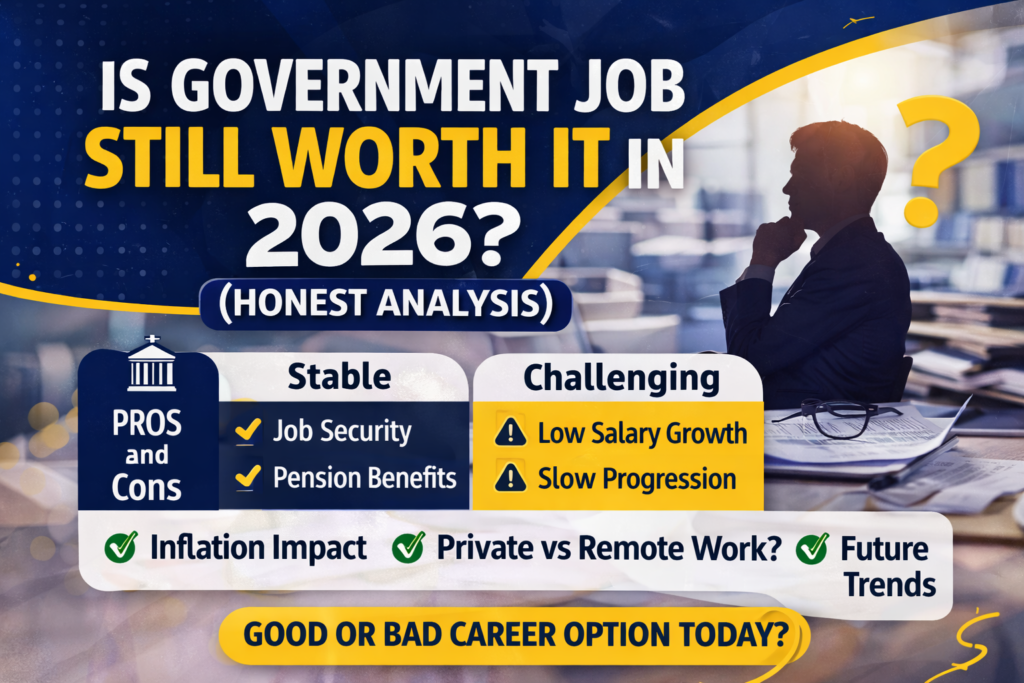
For many years, government jobs have been seen as the safest and most respectable career choice. Parents recommend them, students prepare for them, and society often places a high value on them. But in 2026, the job market has changed significantly. Inflation is rising, private sector opportunities are expanding, and remote work has opened global earning options.
This raises an important question: is a government job still worth it today, or is it simply a traditional mindset that people continue to follow?
This article gives you a clear, honest, and practical analysis based on current realities so you can make a smarter career decision.
1. Inflation Impact: Salary vs Real Life Expenses
One of the biggest factors affecting career decisions today is inflation. The cost of living has increased rapidly, and this directly impacts how far your salary can go.
In major cities, basic monthly expenses such as rent, electricity, food, transport, and daily needs can take up a large portion of income. Even a modest lifestyle now requires a stable and reasonably high monthly earning.
Most entry-level government jobs offer salaries that are stable but not very high. While these salaries increase over time, the growth is slow and often does not match the speed of inflation. This creates pressure, especially in the early years of your career.
At mid-level positions, government salaries improve, but reaching those positions takes time. Promotions are usually based on seniority rather than performance, which means income growth is gradual.
Honest reality: Government jobs provide financial stability, but in many cases, they do not provide strong financial growth in the early stage.
2. Stability vs Growth: What Matters More?
The biggest strength of a government job is stability. Once you are selected, your job is secure. You do not have to worry about sudden layoffs or company closures in most cases.
This security gives peace of mind, especially during economic uncertainty. Many people value this stability because it allows them to plan their life long-term.
However, stability comes with a trade-off.
In government jobs:
- Salary increments follow a fixed structure
- Promotions are often time-based
- Performance has limited impact on fast growth
- Job roles may remain the same for long periods
In contrast, private sector jobs are more dynamic. A skilled employee can grow quickly, switch companies, and increase income within a few years.
Simple comparison: Government jobs offer security and predictability, while private jobs offer speed and financial growth.
3. Private vs Remote Work: A Major Shift
The biggest change in recent years is the rise of remote work. Today, you are no longer limited to jobs in your city or even your country.
With the right skills, people are working for international companies from home. Freelancers, developers, designers, marketers, and content creators are earning income in foreign currencies.
This has created a major shift in career thinking.
In private and remote work:
- Your income depends on your skills
- You can earn more without waiting for promotions
- You have flexibility in working hours
- You can scale your income faster
However, this path also comes with risks:
- No guaranteed job security
- Income may fluctuate
- Requires continuous learning and skill improvement
Honest reality: A skilled person in remote work can earn significantly more than a government employee, but it requires effort, consistency, and risk-taking.
4. Work-Life Balance: Expectation vs Reality
Many people believe government jobs are easy and stress-free. While they often have fixed working hours and less pressure compared to corporate roles, the reality is more balanced.
Government jobs offer:
- Structured working hours
- Less aggressive performance targets
- A predictable routine
But they may also include:
- Slow administrative systems
- Limited innovation
- Less exposure to modern tools and trends
Private and remote jobs, on the other hand, may demand more effort and adaptability but also offer more learning and growth.
Key insight: Government jobs are comfortable, but comfort does not always lead to growth.
5. Future Trends: What is Changing?
The job market is evolving quickly, and government jobs are also being affected by these changes.
Digital Transformation
Government departments are slowly moving toward digital systems, but the speed is still slower compared to private companies. This means fewer opportunities in modern tech-based roles within the public sector.
Contract-Based Hiring
More government roles are now offered on a contract basis instead of permanent positions. This reduces long-term job security and changes the traditional concept of government employment.
Hybrid and Flexible Work
Globally, flexible work models are becoming common. Government sectors are gradually adapting, but change is slow.
Skill-Based Economy
In today’s world, skills matter more than degrees. Employers value what you can do, not just what you have studied.
Future direction: The job market is moving toward skills, flexibility, and adaptability.
6. Hidden Advantages of Government Jobs
Despite all the changes, government jobs still offer strong benefits that should not be ignored.
- Pension and retirement security
- Job stability during economic downturns
- Respect and social recognition
- Fixed working structure
These advantages become especially important during uncertain times when private sector layoffs increase.
7. The Risk Many Candidates Ignore
One common mistake is relying only on government jobs. Many candidates spend years preparing for exams without exploring other options.
At the same time, recruitment processes can sometimes be delayed or even cancelled. This makes it risky to depend on a single path.
You can understand this better by reading:
Why Some Government Vacancies Get Cancelled After Advertisement
This highlights why having multiple career options is important.
8. Who Should Choose Government Jobs in 2026?
Government jobs are still a good choice if you:
- Prefer stability over risk
- Want long-term job security
- Are comfortable with slow growth
- Value routine and structure
9. Who Should Consider Alternatives?
You may want to explore other options if you:
- Want fast income growth
- Are willing to take calculated risks
- Have strong technical or digital skills
- Are interested in remote or international work
10. Smart Career Strategy for Today
The best approach in 2026 is not to rely on a single option.
- Develop valuable skills alongside your education
- Apply for government jobs as one of multiple options
- Explore private and remote work opportunities
This balanced strategy increases your chances of success and reduces uncertainty.
You can also explore better-paying government roles here:
Highest Paying Government Jobs in Pakistan
Final Verdict
Government jobs are still worth it in 2026, but they are no longer the only or best option for everyone.
They are ideal for people who value security, stability, and long-term planning.
However, if your goal is higher income, faster growth, and global opportunities, then private or remote work may be a better path.
The truth is simple: The value of a job depends on your goals, not just the job itself.
Make your decision based on your personality, risk tolerance, and long-term vision.