
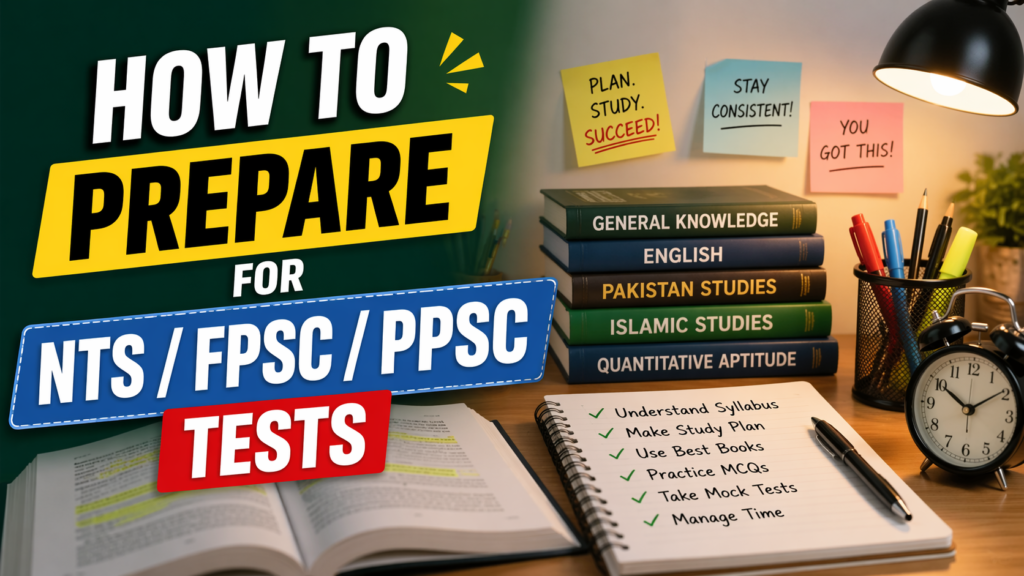
You’ve seen it all before: “Solve past papers daily.” “Read Dawn newspaper.” “Manage your time.” If that advice worked, the success ratio for FPSC and PPSC exams wouldn’t hover in the single digits. The problem isn’t that you aren’t working hard—it’s that you’re working within a broken system. Generic tips fail because they treat a psychological elimination process like a university semester exam.
This article isn’t a list of tips. It’s a real preparation system designed to rewire how you approach the NTS, FPSC, and PPSC gauntlet. We’ll cover the architecture of the test, the specific mental models required for each body, and the strategic framework that turns an average aspirant into a final merit list candidate.
The Hidden Architecture of Competitive Exams: They Are Not Testing Knowledge
This is the most crucial shift you must make. FPSC, PPSC, and NTS do not primarily test what you know. They test how you decide under pressure. When you have 100 questions in 90 minutes (or 120 minutes for FPSC), the board knows you know the material. What they want to see is: Can you discard the 3 hours of irrelevant context your brain is screaming about and pick the right option in 45 seconds?
Understanding this architecture changes everything. You stop trying to be a “scholar of the subject” and start becoming a “tactical test-taker.” The system below is built entirely on this premise.
The 4-Phase Preparation System (The Smart Strategy)
Most candidates oscillate between two unproductive states: reading textbooks cover-to-cover (inefficient) or solving random past papers without context (panic). The system below is linear and strategic.
Phase 1: The Diagnostic Foundation (First 7 Days)
Do NOT open a book yet. The first week is about data collection.
- Syllabus Deconstruction: Print the official syllabus from the FPSC/PPSC/NTS website. Now, take a red pen. Cross out every single topic that hasn’t been tested in the last three years. You’ve just cut your workload by 30%. Examiners have favorite zones; you need to find them.
- The Blind Mock: Take one full-length past paper cold. No preparation. Why? You need a baseline. Did you run out of time in the English section? Did you guess wildly on General Knowledge? This diagnostic tells you exactly which phase of the system needs the most calories. It’s painful, but it’s the only way to know where the bleeding is.
- Resource Mapping: Align the remaining “red line” topics with a maximum of two resources. One book. One online video playlist. That’s it. Resource hoarding is the enemy of depth.
Phase 2: Strategic Consolidation (The Bulk of the Work)
This is where you build the muscle. But we build it specifically for the test format.
- Active Recall, Not Highlighting: Read a concept (e.g., the President’s powers under Article 45). Close the book. Say it out loud in broken English/Urdu as if explaining to a friend. If you can’t explain it without jargon, you don’t know it for the test.
- The Elimination First Approach: While studying options in a multiple-choice context, train yourself to spot why three options are wrong rather than why one is right. This is the single most effective technique for PPSC’s tricky “All of these/None of these” traps.
- Current Affairs vs. General Knowledge: A smart system differentiates. General Knowledge (NTS) is static: Capitals, highest peaks, UN bodies. Current Affairs (FPSC) is dynamic: CPEC updates, IMF tranches, legal amendments. Do not waste time reading 6-month-old newspapers for NTS GAT. Do not rely solely on one-year-old books for FPSC.
Phase 3: Simulated Warfare (The Non-Negotiable)
You cannot win a war without battle drills. You must be uncomfortable.
- Environment Simulation: Do not take mocks lying in bed with chai. Sit at a desk. Set a timer on an oven clock (not your phone—it’s a distraction). Wear the clothes you’ll wear to the exam center. Get your body used to the stress hormone spike.
- Post-Mortem Analysis: Spending 2 hours solving a paper and 5 minutes checking answers is a waste. Spend 2 hours solving and 4 hours dissecting. Categorize every wrong answer: Concept Gap (didn’t know the formula) vs. Execution Error (knew it but misread the date). Most aspirants fail due to Execution Errors, yet they keep studying new concepts. Fix the execution.
Phase 4: The Final Sharpening (Last 72 Hours)
Do not learn anything new. This is a trap that causes panic. In the final three days, you only review your Error Log—the notebook where you wrote down every single silly mistake from Phase 3. Read the first line of every important Ordinance for PPSC Law exams or glance at the Math Formulas Sheet for NTS GAT Quantitative. That’s it. Let the brain rest.
Decoding the Differences: NTS vs. FPSC vs. PPSC
Using the same strategy for all three is like using a hammer to fix a watch and a bulldozer. Here is the specific nuance for each.
NTS: The Speed and Accuracy Game
NTS tests (especially GAT General) are algorithmic. The test is designed by psychometricians to have a very narrow standard deviation. Your strategy here is Sectional Time Locking.
- Verbal: Do not read the whole passage. Read the first line of every paragraph and the last line. The answer is 90% there.
- Quantitative: Use approximation. In NTS, 14.98 * 2.01 is “around 30.” The options are usually far enough apart that you can save 20 seconds by skipping the precise calculation.
- Analytical: Draw a quick, ugly grid. Do not solve in your head.
Unlike FPSC, NTS has a much higher pass/fail cutoff but is more predictable if you master pattern recognition.
FPSC: The Depth and The “Killer” Options
FPSC exams (CSS, Inspector, Preventive Officer) are the most sophisticated. They feature composite questions and qualitative traps.
- Strategy for Islamiat/Pak Affairs: You must know the timeline cold. FPSC loves to give you a correct statement paired with a slightly wrong year. Example: “Simla Deputation (1906)” vs. “Simla Deputation (1905).” One number changes the answer. Create a chronological mind map.
- The English Precis & Composition: This is the graveyard of CSS aspirants. The smart system here is pruning. Write a precis that is 20 words under the limit. Use short, punchy sentences. Never try to impress the examiner; try to be clear. Impressing leads to run-on sentences and grammatical suicide.
PPSC: The Subjective Trap in Objective Garb
PPSC subject specialist tests are deceptively hard because the syllabus is vast (often entire degree curriculum). The smart strategy is weighted study.
- Identify the 80/20 Rule: For Lecturer Economics, 80% of the paper comes from Micro and Macro core concepts. The remaining 20% is scattered over Development Economics, Math Econ, etc. Spend 80% of your time on that core. If you try to cover everything in the PPSC syllabus equally, you will be a jack of all trades and master of none—and that’s exactly who PPSC eliminates.
- Pedagogy Section: Never ignore this. Even if you are a gold medalist in your subject, if you flub the Pedagogy (Teaching Methods) section, you fall below the merit bar. This section alone is often the tie-breaker.
The Resource Arsenal: What to Use and What to Burn
The market is flooded with “Guides.” Most of them are copy-paste trash. Here’s the strategic filter:
- For NTS GAT: Use the official ETS GRE Big Book (freely available online). NTS GAT is a licensed adaptation of the old GRE pattern. Doing local “Caravan” books is like practicing cricket with a tennis ball before a hardball match. It builds false confidence.
- For FPSC: JWT, Jahangir’s World Times, and The CSS Point notes are decent for current affairs compilation, but you must cross-reference facts with the official government websites (PBS, MoF, MoFA). FPSC examiners often check the exact wording from a recent press release.
- For PPSC: University-level textbooks (e.g., S.M. Yusuf for Math, Prof. Ghafoor for Physics) are the only true source. “One-liner” PDFs will get you 40 marks. You need 80+.
The Psychological Edge: The “Mujhe Yahan Job Nahi Karni” Trick
This is the most underrated part of the smart strategy. During the exam, your brain will flood with cortisol. Your vision will narrow. You’ll think, “If I fail this, my year is wasted.” That thought is your enemy.
Use this reverse psychology: Tell yourself at the gate: “Mujhe yahan job nahi karni. Main bas dekhne aya hoon paper kaisa aata hai.” (I don’t want this job. I’m just here to see what the paper looks like.)
This is not self-sabotage; it’s neurological decoupling. By detaching your self-worth from the outcome, you calm the amygdala and allow the prefrontal cortex (the smart part of your brain) to access the information you stored in Phase 2. The candidates who look the most relaxed in the exam hall are often the ones who top it. They understand the game.
Navigating the Bureaucratic Maze: Managing Expectations
Preparation is not just about books; it’s about understanding the system you’re entering. A smart aspirant knows that passing the test is only step one. The real waiting game begins after the result.
You might find yourself on the merit list only to hear radio silence for months. This is where many candidates lose their minds—and sometimes, their opportunity. It is crucial to understand the legal and administrative machinery behind the advertisement. For a deep dive into the reasons behind these frustrating delays, I recommend reading Why Some Government Vacancies Get Cancelled After Advertisement. It explains the court cases, funding issues, and policy changes that can suddenly pause a recruitment drive. Knowing this in advance prevents you from putting your life on hold indefinitely based on a single test result. Keep your engine running elsewhere.
Beyond the Test: The GEPCO Housing Example and Patience
While you’re preparing for NTS or FPSC, don’t ignore specialized departmental opportunities that have a shorter, more focused recruitment cycle. For instance, many candidates overlook sector-specific tests for organizations like WAPDA, DISCOs, or housing foundations. These often follow a different pattern and have a higher success probability due to a smaller applicant pool.
Take the recent example of GEPCO Employees Housing Foundation Gujranwala Jobs. These positions require a similar NTS-style screening but with a much narrower subject focus (civil engineering, finance, etc.). Applying your smart strategy to these niche vacancies can be a faster route to a stable government position while you continue the longer grind for CSS or PPSC Lecturership. Diversify your test portfolio; never rely on one exam cycle.
Conclusion: The System Rewards the Patient Strategist
Preparing for NTS, FPSC, and PPSC is a marathon run at sprint intervals. The generic advice of “just study hard” ignores the reality of cut-throat competition and psychological warfare. By adopting a 4-Phase System, by understanding the specific architecture of each testing body, and by managing your expectations regarding the bureaucratic delays post-exam, you transition from a hopeful applicant to a calculated professional.
The real preparation system is simple: Study less material, but study it deeper. Make more mistakes in practice, so you make zero on test day. And never, ever let the exam see you sweat.