
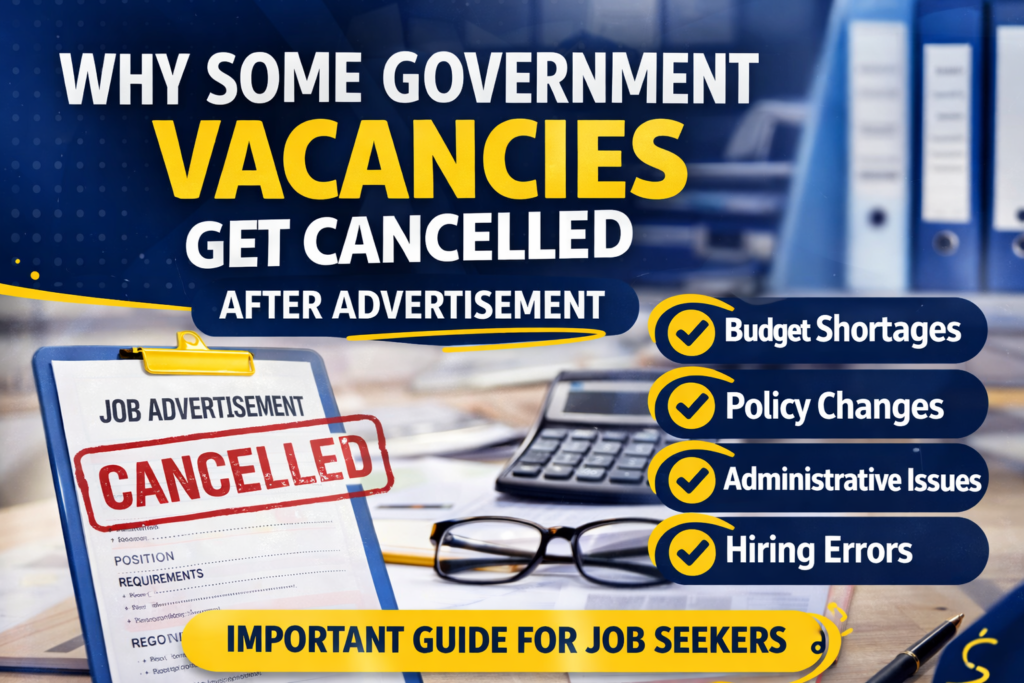
One of the most frustrating experiences for job seekers is seeing a government vacancy announced, preparing for it, and then suddenly hearing that the recruitment has been cancelled. This situation is more common than many people think, especially in public sector hiring.
Understanding why this happens can save you time, reduce frustration, and help you plan your job strategy more realistically. In this guide, we will break down the real reasons behind job cancellations in a simple, practical way.
1. Government Policy Changes and Reforms
One of the biggest reasons behind cancelled vacancies is policy change. Governments frequently review their departments and may decide to restructure or reduce staff.
For example, large-scale “rightsizing” initiatives have led to the abolition of thousands of government posts to reduce expenses and improve efficiency.
When such decisions are made, even already advertised jobs can be withdrawn because the positions no longer exist.
2. Budget Constraints and Financial Issues
Government hiring depends heavily on budget approvals. Sometimes, vacancies are announced based on expected funding, but later the budget is reduced or reallocated.
In such cases, departments may cancel recruitment because they simply cannot afford to hire new employees.
This is especially common in economic crisis periods or when governments prioritize cost-cutting measures.
3. Department Mergers or Closure
Another major reason is structural changes. When departments are merged, reorganized, or even shut down, their hiring plans are also affected.
Recent reforms in Pakistan have included merging ministries and reducing the number of institutions, which directly impacts job availability.
If a department no longer exists in its original form, the recruitment process becomes irrelevant and is cancelled.
4. Administrative or Legal Issues
Sometimes vacancies are cancelled due to internal administrative problems such as:
- Errors in job advertisement
- Incorrect eligibility criteria
- Problems in quota distribution
- Legal challenges or court cases
In some cases, recruitment is stopped even after tests or interviews due to “administrative reasons,” which can include policy review or procedural mistakes.
5. Shift to Outsourcing Instead of Hiring
Many governments are now moving toward outsourcing services instead of hiring permanent employees. This reduces long-term financial burden and avoids future demands for regularization.
There have been cases where recruitment processes were cancelled even after tests because authorities decided to outsource those roles instead.
This trend is increasing, especially for support staff and contract-based roles.
6. Overstaffing or Reduced Need
Sometimes departments realize that they already have enough employees or that the workload does not justify new hiring.
In such cases, advertised vacancies may be cancelled to avoid unnecessary expansion of the workforce.
This is often linked with performance reviews and efficiency audits.
7. Political Changes and Government Transitions
Changes in government or leadership can also impact recruitment. A new administration may:
- Review previous hiring decisions
- Pause recruitment temporarily
- Cancel projects linked to earlier policies
This is why some vacancies disappear after elections or major political shifts.
8. Errors in Recruitment Planning
Not all cancellations are due to major reasons. Sometimes it is simply poor planning.
A department may announce vacancies without completing internal approvals, and later realize that the hiring process cannot proceed.
This leads to cancellation before or during recruitment.
9. Quota and Compliance Issues
Government jobs must follow strict quota systems (provincial, minority, disability, etc.). If there is any issue in quota allocation or compliance, recruitment may be stopped.
In some cases, vacancies remain unfilled or cancelled because departments cannot properly implement quota requirements.
10. “Ghost Vacancies” or Pipeline Hiring
In rare cases, some vacancies are announced to build a candidate pipeline rather than immediate hiring. Research shows that a portion of job ads may not lead to actual hiring, sometimes called “ghost jobs.”
While more common in the private sector, similar patterns can occasionally appear in public hiring processes.
Real Impact on Job Seekers
Job cancellations can waste time, effort, and money. Candidates often spend weeks preparing, paying fees, and attending tests — only to see the process stopped.
This is why experienced applicants never rely on a single job opportunity. They always apply for multiple positions to reduce risk.
How to Protect Yourself as an Applicant
You cannot control cancellations, but you can minimize their impact:
- Apply to multiple jobs instead of relying on one
- Prefer well-established departments with stable hiring
- Avoid over-investing time in uncertain or contract-based roles
- Stay updated with official announcements
Also, understanding the hiring process helps you stay prepared. You can read this guide on
highest paying government jobs in Pakistan
to explore more stable career options.
Related Opportunity
If you are actively applying, you can also check recent openings like:
Aga Khan Education Service Pakistan Jobs 2026
Exploring multiple opportunities increases your chances and reduces dependency on a single recruitment process.
Final Thoughts
Government job cancellations are not random. They usually happen due to policy changes, financial constraints, restructuring, or administrative issues.
Instead of getting discouraged, understand the system and plan accordingly. The smartest candidates don’t just apply — they adapt.
In government job preparation, consistency matters more than any single opportunity. Stay focused, keep applying, and your chances will improve over time.